


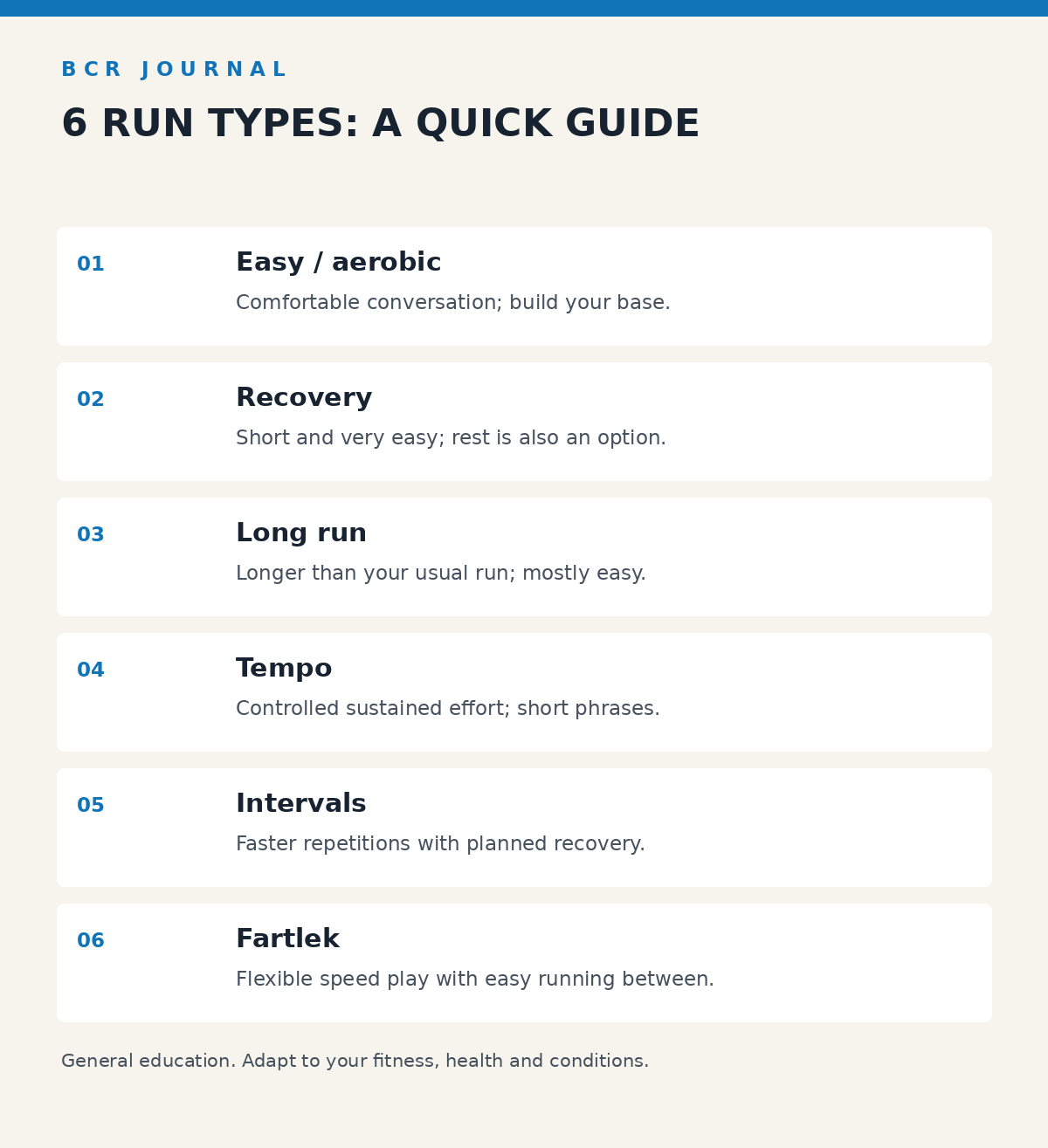
Not every run needs to feel the same. Some sessions build endurance with manageable effort; others introduce sustained faster running or short bursts. Knowing the purpose helps you avoid the common trap of making every day moderately hard. These names are useful coaching shorthand, not six completely separate energy systems.
1. Easy or aerobic run
Run at an effort that allows comfortable conversation. Pace will vary with fitness, hills, heat and fatigue. This is the foundation of a repeatable routine. A practical example for someone already comfortable running is 20–30 minutes of relaxed running, with walk breaks if needed. New runners can use easy walk–jog sessions instead.
2. Recovery run
A recovery run is deliberately short and very easy, commonly used between more demanding sessions by experienced runners. It adds gentle running without aiming for a training breakthrough. It does not automatically speed recovery, and it is not obligatory. If you feel unusually tired, sore or unwell, rest or gentle walking may be the better choice.
3. Long run
“Long” is relative to your current routine. It means a session longer than your usual run—not an automatic 15K or 20K target. Usually keep it easy and extend it gradually only as your overall training supports it. For someone used to comfortable 25-minute runs, a slightly longer easy outing may be enough. Avoid making one huge run compensate for an inconsistent week.
4. Tempo run
Tempo usually describes a controlled, sustained effort that feels noticeably harder than easy running. Short phrases may be possible, but chatting freely is harder. Definitions vary between coaches. After a consistent base, a coach might introduce short controlled blocks separated by easy jogging. It should not turn into an all-out time trial, and it needs an easy warm-up and cool-down.
5. Intervals
Intervals are planned repetitions with recovery between them. They can be prescribed by time or distance, and the purpose depends on their length, speed and recovery. A modest introductory example for an established runner is four one-minute controlled faster efforts, with about two minutes easy walking or jogging between them. Faster does not mean sprinting. Finish with control rather than forcing one extra repetition.
6. Fartlek: speed play
Fartlek mixes easier running with varied faster sections, often using landmarks or time. Compared with formal intervals, the structure can be more flexible. After warming up, an established runner might alternate short relaxed surges with generous easy recovery. Use safe landmarks and clear paths; do not surge through traffic or uneven ground.
How to combine them
Beginners do not need all six in the same week. Start with easy running or walk–jog sessions and recovery days. Once the habit is established, add a little variety with coaching guidance. A hard tempo or interval session is still a hard day, regardless of how short its faster sections are. Leave recovery between demanding sessions.
Use effort before pace
These categories overlap: a long run can be aerobic, and tempo and intervals still use substantial aerobic energy. In Ballari’s heat, a pace you normally call easy may become demanding. Slow down, take a walk break or shorten the session rather than forcing a label. Ask yourself: what is today’s purpose, and does the effort match it?
Your next step with BCR
Want company for your next session? Message BCR on WhatsApp to check the current meeting point and suitable group. Tell us if you are new or returning so we can help you start at a comfortable level.
General training education, not an individual medical or coaching prescription. If you have health concerns, current pain or a condition that affects exercise, seek appropriate professional advice.