


Your first 5K begins long before the start line. It begins with choosing a small session you can repeat. You do not need to run fast, buy every gadget or keep up with the strongest person in the group. You need a manageable starting point, recovery and a little patience.
1. Make walking your starting line
If you have been inactive, start with comfortable walks. Build towards a brisk 20–30-minute walk that feels manageable during the session and afterwards. This is a useful readiness check, not a test you must pass on a particular day. Choose a safe, familiar route and comfortable footwear. If exercise raises health concerns, speak with a doctor before starting.
2. Try a gentle walk–jog session
After about five minutes of easy walking, try jogging gently for one minute, then walking for 90 seconds. Repeat a few times—perhaps six to eight rounds if comfortable—and finish with an easy walk. The jog should feel controlled. If you are gasping, slow down or shorten it. Note that this is not a personal plan, and the training and effort differs from person to person.
3. Use three separated sessions, not a daily challenge
Three sessions a week with a rest day between them is a practical starting structure. For example, Tuesday, Thursday and Saturday leaves room to recover. A missed session does not create a debt: resume the routine instead of squeezing two runs together. Gentle walking on another day is fine if you feel comfortable.
4. Progress when the current step feels repeatable
Gradually lengthen the jogging sections while keeping walk breaks. Move from short repeats to longer blocks (like 6 reps of 90 sec continuous jogs, or 4 reps of 2 min continuous jogs), then towards continuous easy running if that suits you. Repeat a stage whenever needed. Do not simultaneously add speed, duration and extra training days. There is no universal percentage that guarantees safe progression.
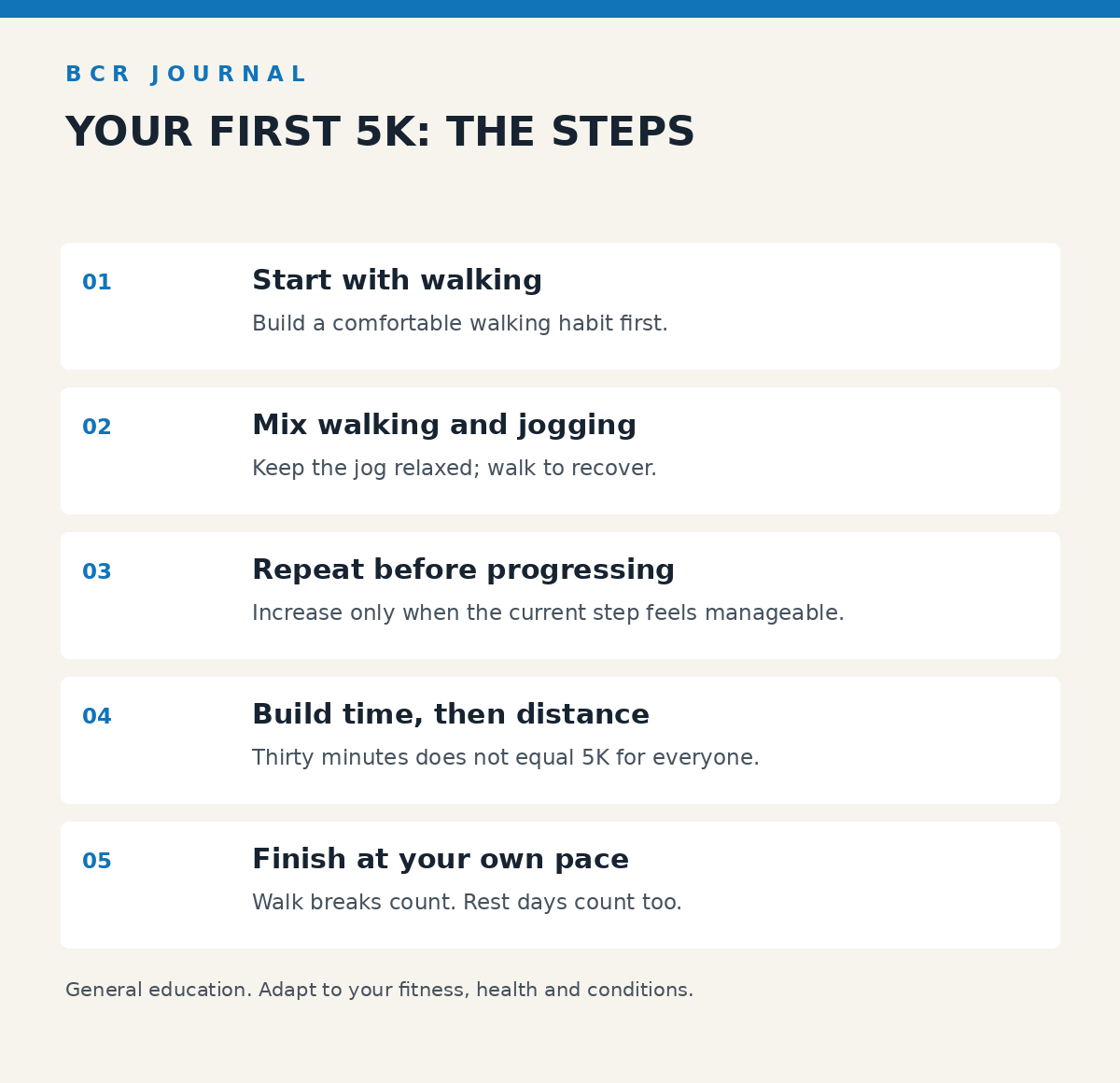
5. Separate a time goal from a distance goal
A programme that builds towards 30 minutes of continuous running does not mean everyone covers 5K in 30 minutes. You may need longer to complete the distance, and walking some of it is completely valid. A standard Couch to 5K is usually organised across 8-12 weeks, with the option to take longer. Your timeline can differ.
6. Practise the finish, without racing every session
When you feel ready, choose a familiar 5K route or a supported event. Begin gently, take planned walk breaks if useful and focus on finishing feeling in control. Avoid chasing another runner’s watch pace. In a place like Ballari, use cooler hours and adapt the session when the heat makes your normal effort harder.
When to pause
Ordinary muscle tiredness and pain that changes your stride are different signals. Stop for sharp or worsening pain, dizziness, chest pain or unusual breathlessness. Seek medical help for concerning symptoms rather than pushing through. The real milestone is a routine you can return to—not a perfect streak.
Your next step with BCR
Want company for your next session? Message BCR on WhatsApp to check the current meeting point and suitable group. Tell us if you are new or returning so we can help you start at a comfortable level.
This is a general training education, and not an individual medical or coaching prescription. If you have any health concerns, current pain or a condition that affects exercise, seek appropriate professional advice.