


An aerobic run is an easy run you can keep going with while still talking comfortably. You finish feeling that you could have done a little more. The aim is to build stamina, rather than run your fastest time.
If you are new to running, this may sound strange. Why slow down when you want to get better? Because you need training you can repeat. Running hard every day can leave you tired before the next session even starts. Easy running gives you another way to improve.
What does “aerobic” mean?
Aerobic means your body uses oxygen to help release energy for movement. For this article, an aerobic run means a comfortable, steady run. Coaches also call it an easy run or base run. “Base” simply means the fitness you build before adding harder training.
Faster runs also use oxygen, so easy and fast running are not two separate on/off systems. You do not need to learn the science to start. Remember this: an easy run should allow a conversation.
Why are easy runs useful?
Regular easy running helps you get used to spending time on your feet. Over time, your body becomes better at supporting longer efforts. A route that once needed several walking breaks may gradually feel more manageable.
Easy runs usually leave you less tired than hard sessions of a similar length. That makes it easier to fit running around work, family, strength sessions and rest. They are useful whether you want to finish your first 5K or build towards a longer race.
Easy does not mean unlimited. A long easy run can still be tiring. Add time gradually and leave room to recover. You do not need to finish exhausted to prove that the session counted.
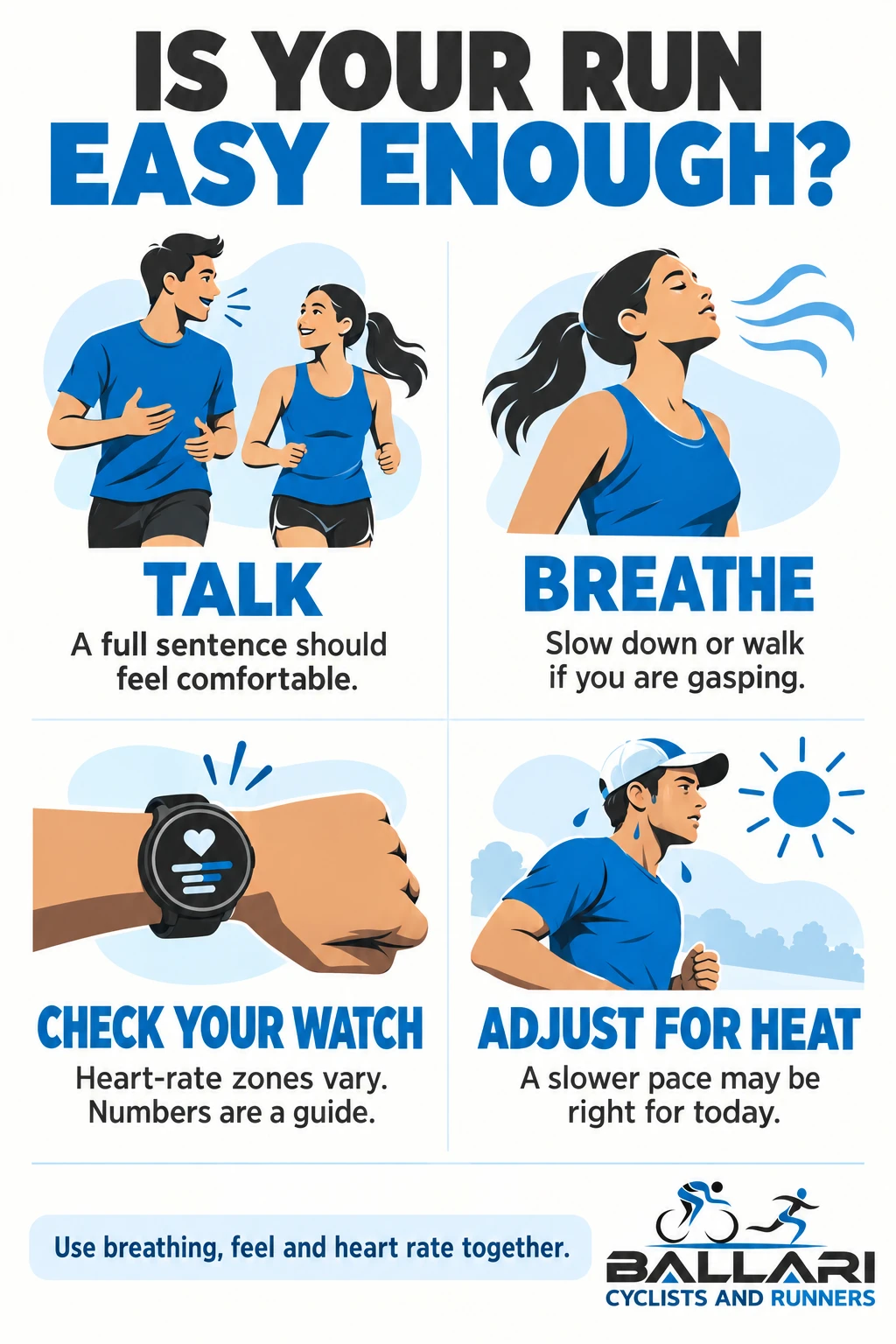
The simplest check: can you talk?
After you have warmed up, speak a normal sentence to a running partner. For example: “Let us keep this pace until the next turning.” You should be able to say it comfortably, without breaking it into two or three pieces to catch your breath.
- A comfortable sentence: you are probably close to the easy effort you want.
- Only a few words at a time: slow down or take a walking break.
- Gasping or struggling to speak: this is too hard for an easy run.
You can do the same check when running alone. Say a sentence out loud occasionally. Do not hold your breath or force the words just to pass the test. Nose-only breathing is not compulsory; breathing through your mouth does not automatically mean you are running too hard.
What should the effort feel like?
Your breathing will be quicker than when sitting, but it should feel under control. Your shoulders and hands should stay relaxed. You should not need to keep pushing yourself to hold the pace. If the run already feels like a race, ease off.
There is no fixed easy-run speed. One person may jog comfortably at a pace that makes someone else breathless. If you are starting out, brisk walking or short walk–jog sections may give you the right effort. You are still building fitness.
What is my aerobic running heart rate?
Heart rate is how often your heart beats in a minute. A watch displays it as beats per minute, usually shortened to bpm. It can help you check effort, but there is no one aerobic heart rate that suits everyone. Your age, fitness, medicines and the way your watch sets its zones all matter.
A heart-rate zone is just a range of numbers used to describe training effort. Many runners use the name “Zone 2” for easy training. Be careful: different watches and coaches calculate those zones differently.
In Garmin’s simple system based on maximum heart rate, Zone 2 is 60–70% of your maximum. Maximum heart rate means the highest rate your heart can reach during very hard exercise. This zone is a starting guide, not a test that proves your personal aerobic limit.
A number example, with an important limit
One common rough estimate for maximum heart rate is 220 minus your age. If you are 40, the estimate is 180 bpm. In that example, 60–70% gives about 108–126 bpm. These are estimated numbers for one zone system, not a prescribed target.
Using the same method, the rough examples are: age 30, 114–133 bpm; age 50, 102–119 bpm; age 60, 96–112 bpm. Real maximum heart rate can differ considerably from an age-based estimate. Two people of the same age may need different training ranges.
If the estimated range means you need to walk, walking is a valid choice. If the range and your breathing repeatedly disagree, ask a coach to check the zone settings. Do not speed up just to reach a number, or ignore unusual symptoms because the watch says “easy”.
How can I find a more useful range for myself?
- Start with the talk test on a flat route, after an easy warm-up. Notice the heart rate when conversation genuinely feels comfortable.
- Repeat on a few normal days. Keep a simple note of the effort, weather and watch reading. This helps you recognise your usual easy effort; it does not diagnose a precise threshold.
- Check how your watch calculates zones: maximum heart rate, resting heart rate or another setting. Percentages from different methods cannot be swapped directly.
- For a more individual assessment, ask a qualified coach or sports clinician about suitable testing. Supervised exercise tests can measure how breathing and effort change. Do not do an all-out test on your own just to find a number.
Keep the watch snug as recommended by its maker. Wrist readings can sometimes lag or jump. A suitable chest strap may give more dependable readings if accurate heart-rate tracking is important to your training. A watch remains a training tool, not a medical check.
Why Ballari’s heat changes the pace
On a hot morning, your usual running speed can feel much harder. Your heart rate may also rise as the session continues. Keeping yesterday’s pace at all costs can turn today’s easy run into a hard one.
Choose cooler hours, carry or arrange water, and be willing to shorten the session. Slow down on a hill or when the heat builds. If comfortable conversation returns only when you walk, walk. An easy run is judged by the effort, not by matching last week’s speed.
Stop for dizziness, chest pain, faintness or unusual breathlessness. Seek medical help for worrying symptoms. Do not treat a heart-rate target as permission to push through.
A simple session to try
If you already run comfortably, begin with about five minutes of walking or very easy jogging. Continue with 15–20 minutes at a pace where you can talk. Finish with a few minutes of gentle walking. Shorten it if that is more than you are used to.
If you are a beginner, try short relaxed jogging sections with generous walking breaks instead. Repeat a comfortable session before adding more time. You do not have to run continuously for it to be useful.
Questions runners often ask
Will slow running make me slower? Easy runs support the fitness you need for running. They do not replace every faster session when your goal calls for one. Beginners can first build a steady habit; a coach can add faster work later.
Should all my runs be easy? Not necessarily. Your experience, goal and recovery decide the mix. There is no single weekly percentage that everyone must follow.
Can I run with a faster friend? Yes, if the friend is happy to match your effort. If you cannot talk comfortably, let them go ahead or agree on a walking break.
Must I buy a heart-rate watch? No. Conversation, breathing and how you feel are useful starting checks. A watch adds information; it is not an entry ticket to running.
Join an easy run with BCR
New or returning to running in Ballari? Message Ballari Cyclists and Runners on WhatsApp to check the current meeting point and suitable group. Tell the coordinator you want a comfortable pace or walk–jog option.
This is general exercise information. If you have a heart condition, take medicine that affects your heart rate, or have pain or other health concerns, ask a qualified health professional what is suitable for you.
Read next
- From couch to your first 5K
- Hydration when training in Ballari’s heat
- Six main types of run, explained