

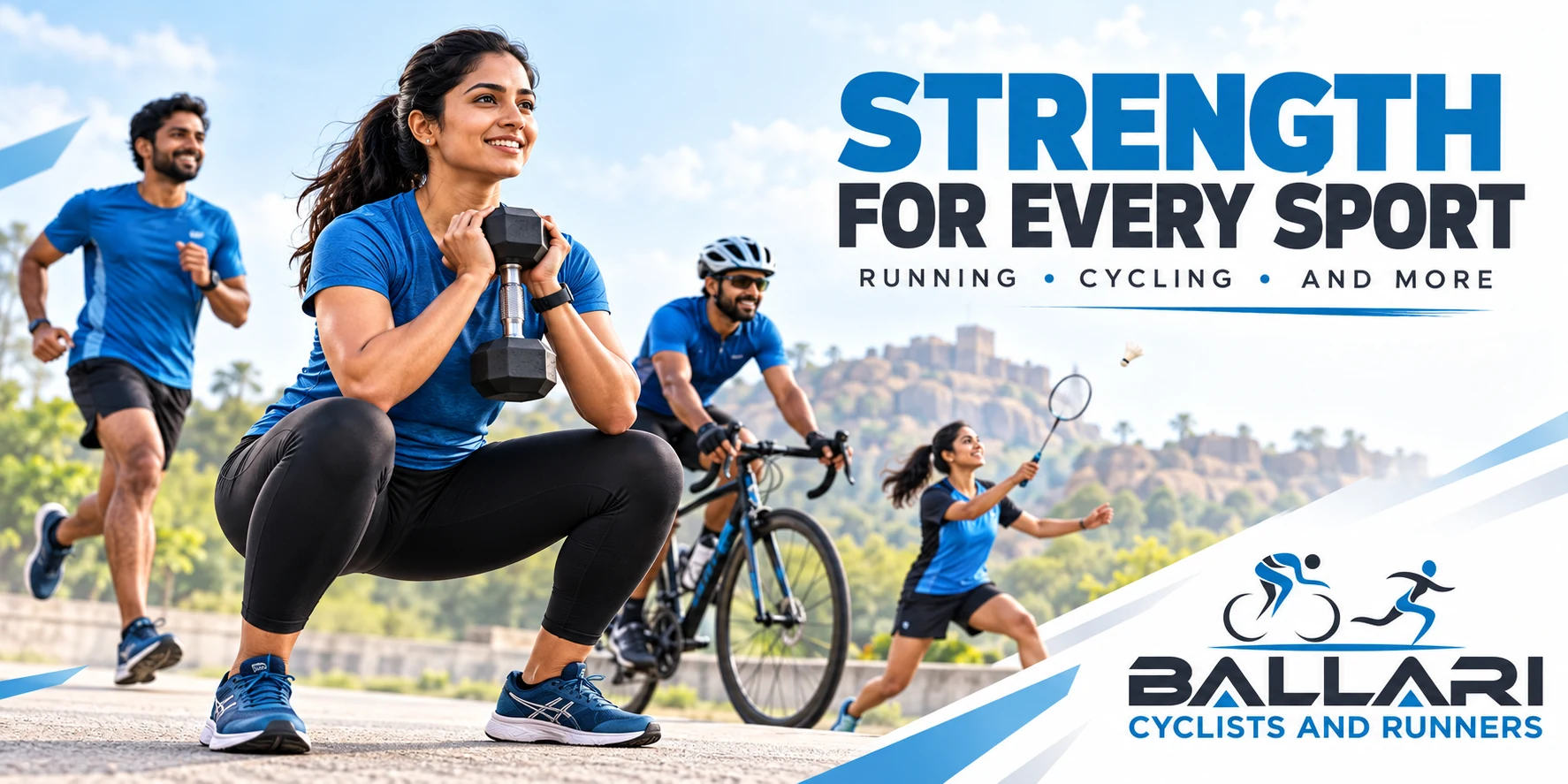
You might run regularly, ride every weekend or enjoy a game of badminton. You practice your sport because you want to get better at it. So where does strength training fit in?
Think of it as preparing your body to handle what your sport asks of it. Running means repeatedly landing and pushing off. Cycling means turning the pedals, climbing and holding a riding position. Court and field sports add sudden stops, turns, jumps and changes of direction. Stronger muscles can help you do these jobs with more control.
You still need to practise your sport. Strength training is a supporting activity: it helps build the body that does the running, riding or playing. You do not have to become a bodybuilder though to benefit.
Why strength training matters for sport
Strength is your ability to produce force. That could mean pushing against a pedal, pushing off the ground or slowing down before a turn. Training against a suitable resistance, such as your body weight, a band or a dumbbell, gives your muscles a reason to become stronger over time.
Better strength can make a familiar task use a smaller share of your available effort. It may help you keep control as a session goes on, cope with hills or move more confidently on court. It does not make every workout easy, but it can give you more capacity for the work.
Research suggests that appropriate strength programmes can improve running economy, which means using less energy at a given running pace. Research in cyclists also suggests benefits for power and performance, although the evidence has limitations and results vary. These findings come from planned programmes; they are not a reason to start with heavy weights on day one.
Train the muscles your sport needs — and keep the whole body involved
Different sports place different demands on us. Choosing useful movements matters more than collecting lots of exercises.
- Running: the buttock muscles, thighs and calves help with landing, supporting your weight and pushing off. The muscles around your middle help you control your trunk while your arms and legs move. Single-leg work is useful because running involves supporting yourself on one leg at a time.
- Cycling: the front and back of the thighs and the buttock muscles contribute to pedalling. Your trunk and upper back help you hold and control your position on the bike. Training these areas supports riding; it does not replace a suitable bike fit.
- Court and field sports: strong legs and hips support stopping, jumping and changing direction. The trunk helps transfer force between the lower and upper body. Shoulder and upper-back strength may matter for throwing, swimming or racket movements, depending on the sport.
These muscles work together. A squat or lunge trains several areas at once. Most people benefit from a balanced base of leg, hip, pushing, pulling and trunk exercises, with extra work chosen for their sport. A swimmer and a cyclist need not follow the same programme.
Can strength training lower the chance of injury?
Well-planned strength training can help muscles and other tissues build the capacity to handle load. Research across several sports has found fewer injuries in groups following suitable strength programmes. That is encouraging, but it does not mean strength training prevents every injury, or that the same routine works equally well for every sport.
Training too much too soon, ignoring pain or lifting beyond your control can create problems. Your total sport workload, recovery, technique and equipment still matter. Strength work belongs alongside sensible training and rest, rather than being used to cancel out an overloaded week.
If you already have an injury, choose exercises and loads with a qualified clinician or coach who understands your situation. Do not copy a teammate’s routine just because it worked for them.
How it can help you enjoy your sport more
Enjoyment is not only about a faster finish time. It can be feeling steadier on a climb, more confident in a turn or better able to keep playing with friends. When your body feels more capable of the work, you may spend less of the session worrying about whether you can manage it.
Strength training cannot promise pain-free sport or enjoyment for everyone. But a routine that suits you can support confidence and make regular participation feel more manageable. The goal is to help you keep doing the sport you like.
Six foundation movements worth learning
These are useful starting movement families, not a compulsory programme for every person. Learn a controlled version first, then choose resistance you can manage. A coach can help with technique and suitable variations.
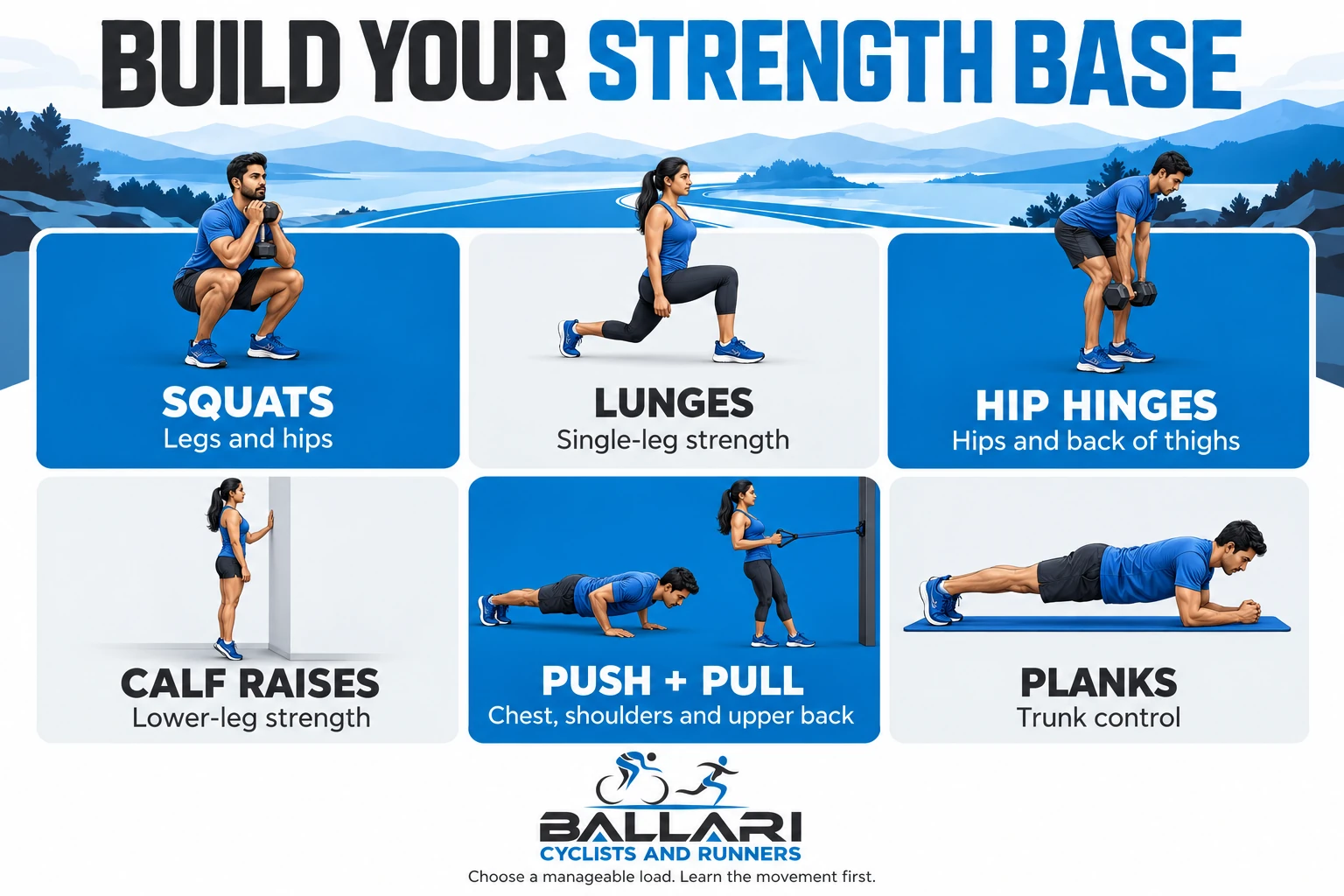
1. Squats. Bend at the hips and knees to lower yourself, then stand back up. Keep your feet planted and use a depth you can control comfortably. Start with body weight or a goblet squat, holding one dumbbell close to your chest. Squats train the thighs and buttock muscles, building a base for running, pedalling, jumping and getting into an athletic position.
2. Lunges or split squats. A reverse lunge involves stepping back and lowering under control. A split squat keeps the feet in a staggered position while you lower and rise. Both train the legs and hips with more work on one side at a time. They help develop single-leg strength and control for running and sports that involve stepping, stopping or changing direction. Use support for balance if needed.
3. Hip hinges, such as a Romanian deadlift. With a small bend in the knees, move your hips back and then stand tall again. Learn the movement before adding dumbbells. This works the buttock muscles and the back of the thighs. Those areas contribute to propulsion and control in many sports. Keep the load close and avoid forcing yourself into a depth you cannot control.
4. Calf raises. Rise onto the balls of your feet, then lower slowly. Begin on a flat floor, using support if needed; resistance or single-leg versions can come later. The calf muscles contribute to running push-off and help control the lower leg in activities involving jumping and footwork. Straight-knee and slightly bent-knee versions emphasise different calf muscles.
5. A push and a pull. Pair a suitable push-up or dumbbell press with a resistance-band or dumbbell row. Pushing trains the chest, shoulders and arms; pulling trains the upper back and arms. This gives the upper body a balanced base for many sports, including racket activities and maintaining control on a bike. Choose a push-up height or weight that lets you move without straining.
6. Planks or side planks. Hold a position in which your trunk stays steady while you breathe normally. Stop before you lose control or start holding your breath. These train the muscles around your middle to resist unwanted movement. That control helps connect the work of your legs and upper body in running, riding and many other sports. A good short hold is more useful than a long, strained one.
How to fit strength work around your sport
Two sessions on separate days can be a practical starting point for many adults. If strength training is new to you, begin with a shorter session and add gradually. You do not need to train every movement hard from the first week.
For example, a healthy beginner who has learned the movements might start with one or two sets of a squat, lunge, hip hinge, calf raise, push and pull. Around 6–12 controlled repetitions per set can be a useful starting range, but the appropriate amount depends on the exercise, load and person. Keep plank holds short enough to stay steady and breathe. This is an example, not an individual prescription.
Finish a set feeling that you could still manage another two or three good repetitions. Rest until you can perform the next set properly. When the same exercise feels controlled across several sessions, increase one thing a little: the weight, repetitions or difficulty. You do not need to increase everything together.
Plan demanding leg work around important sport sessions. Avoid trying a hard new strength workout just before a long ride, race or match. If combining sport and strength on one day, put the session that matters most first and allow enough recovery. Reduce the strength load when your sport schedule becomes unusually demanding.
Some muscle soreness can happen after unfamiliar work. Soreness is not proof of a better workout. Sharp pain, worsening joint pain or a change in your normal movement is a reason to stop and get advice.
Starting with Ballari Cyclists and Runners
If you want help choosing a suitable starting routine, message Ballari Cyclists and Runners for current strength-session details. Tell the coach which sport you do, how often you train and whether you have any injury or pain. That information helps make the strength work useful for you.
In Ballari’s warm weather, choose a suitable training space, keep water available and allow breaks. Being fit at running or cycling does not automatically mean you are ready for heavy lifting. Give yourself time to learn.
Common questions
Will strength training make me bulky? Not automatically. Muscle growth depends on the programme, food and time. A sensible sport-support routine can focus on strength and control without making muscle size your main goal.
Is running or cycling already enough leg training? It develops the fitness and skill needed for that activity, but does not provide exactly the same challenge as controlled resistance work. Strength training adds a different stimulus; keep practicing your sport too.
Do I need a gym? No. Body-weight squats, lunges, push-ups and planks can start the process. Bands or dumbbells provide more options for pulling and gradually adding resistance. The equipment matters less than a suitable routine you can repeat.
Should every athlete follow the same exercises? No. These foundation movements are a base. Your sport, experience, schedule and injury history should shape the final programme. More advanced sport-specific work should follow a solid foundation.
This article offers general exercise information. If you have an injury, a medical condition or symptoms during exercise, ask a qualified health professional what is suitable for you.
Read next
- From couch to your first 5K
- Hydration when training in Ballari’s heat
- Six main types of run, explained